
A to Z of Online Sports Betting Terms & Slang (The Complete Index)
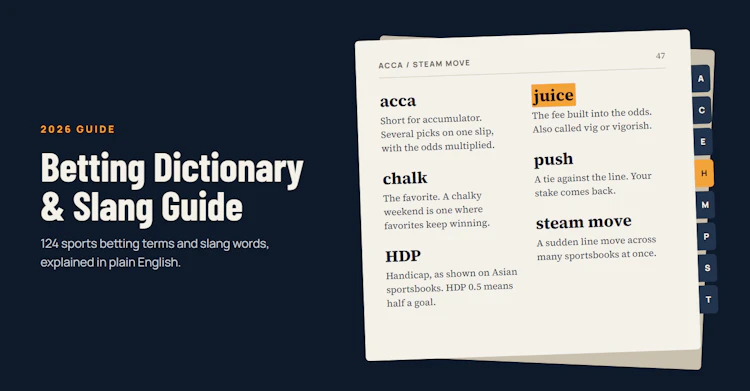 From acca to steam move, every betting term in this guide comes with a plain-English definition.
Every term below gets a short, plain-English definition, grouped alphabetically so you can jump straight to the word you need. Where two words mean the same thing, you will find a cross-reference like "see Dog".
Betting Terms A to B
- Accumulator (Acca): One bet slip that combines selections from several events, where the odds multiply, and every pick must win.
- Action: Any bet that is live and counts. Having "action" on a game means you have money riding on it.
- Against the Spread (ATS): A team's record measured against the point spread rather than wins and losses, common in US sports.
- American Odds: Odds with a plus or minus sign. +150 means RM 150 profit on a RM 100 stake, and -150 means you stake RM 150 to win RM 100.
- Ante-Post: A bet placed well before an event, often at higher prices, but usually with no refund if your pick pulls out.
- Arbitrage (Arb): Backing every outcome of an event at different sportsbooks so the combined odds lock in a small profit, whatever happens. Also called a surebet.
- Asian Handicap: A handicap format that removes the draw, using half, whole, and quarter-goal lines so every bet has just two sides.
- Back: To bet on something happening. On a betting exchange, it is the opposite of lay.
- Backdoor Cover: When a team covers the spread thanks to a late, meaningless score after the result was already decided.
- Bad Beat: A bet that looked certain to win but lost at the last moment, like a stoppage-time equalizer.
- Banker: The pick you trust most in an accumulator, or a fixed selection used in every line of a system bet.
- Bankroll: The total money you set aside only for betting, kept separate from everyday funds.
- Beard: Someone who places bets for another person to hide who is really betting, often for a professional who has been limited.
- Bet Builder: A tool that combines several markets from one match into a single bet. See Same Game Parlay.
- Betting Exchange: A marketplace where bettors bet against each other instead of a bookmaker, with the exchange taking a commission on winnings.
- Betting Slip (Bet Slip): The panel showing your selections, stake, and potential return before you confirm a bet.
- Bettor: The American word for someone who places bets, often misspelled as "better".
- Both Teams to Score (BTTS): A bet on whether both teams score at least one goal.
- Bookmaker (Bookie): The company or person that sets the odds and accepts bets, today usually an online sportsbook.
- Buck: US slang for a $100 bet.
- Buying Points: Accepting worse odds to move a spread or total in your favor, such as taking -2.5 instead of -3.
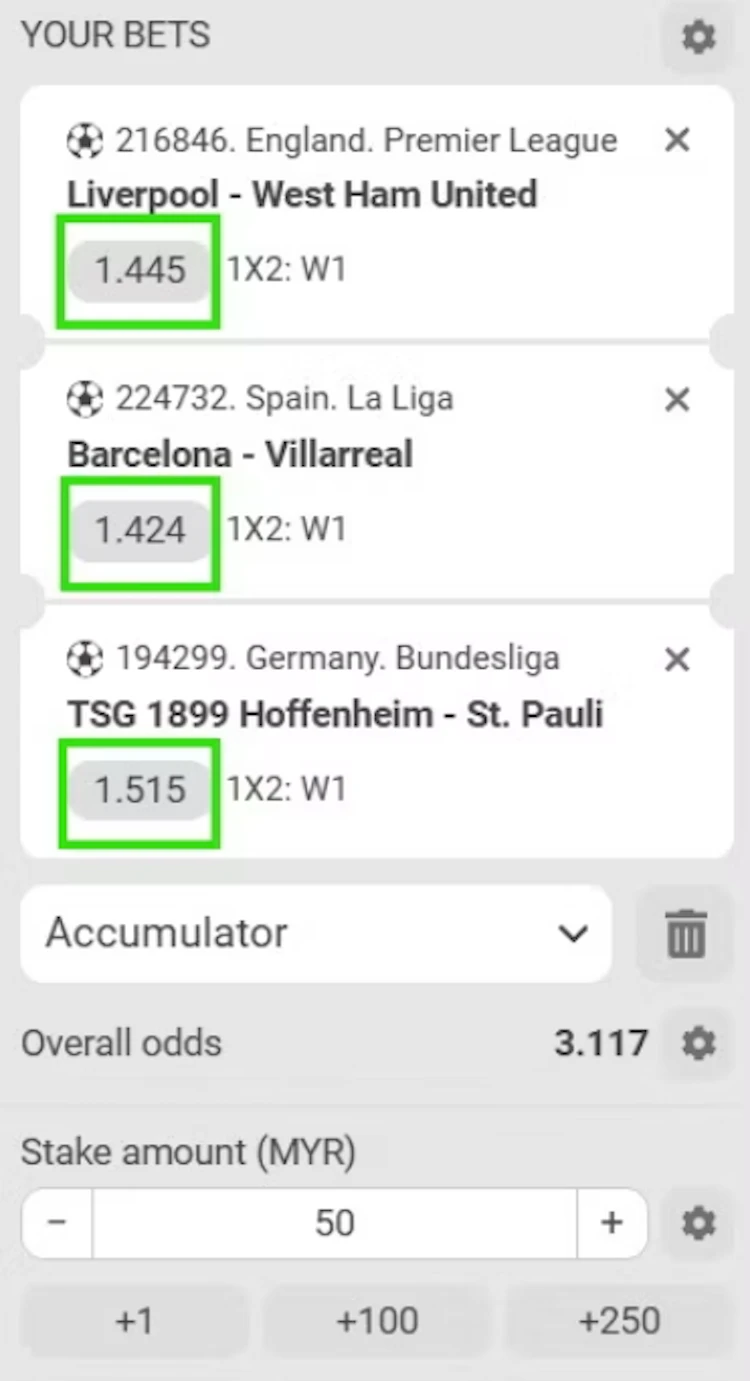 A three-pick accumulator: odds of 1.445, 1.424 and 1.515 multiply to 3.117, so a RM 50 stake returns about RM 155.85 if all three teams win.
Betting Terms C to D
- Cash Out: Settling a bet early for whatever value the sportsbook offers before the event ends.
- Chalk: The favorite. A "chalk bettor" mostly backs favorites, and a "chalky" weekend is one where favorites keep winning.
- Chasing Losses: Raising stakes or betting more often to win back lost money, one of the clearest warning signs of problem gambling.
- Closing Line: The final odds before an event starts. Regularly getting better odds than the close, known as closing line value (CLV), is the most trusted sign of a skilled bettor.
- Combination Bet: Any bet that links several selections, such as doubles, trebles, and system bets.
- Consensus: The share of bets or tipster picks on each side of a game, usually shown as percentages.
- Correct Score: A bet on the exact final score of a match.
- Cover: When a team beats the point spread. A -3.5 favorite covers by winning by four or more.
- Dead Heat: A tie between two or more winners, usually settled by splitting your stake between them.
- Decimal Odds: Odds shown as one number that includes your stake, so 2.50 returns RM 250 from a RM 100 bet.
- Degenerate (Degen): Tongue-in-cheek slang for someone who bets on anything at any hour. Funny online, but a real warning sign offline.
- Dime: US slang for a $1,000 bet.
- Dog (Underdog): The team or player less likely to win, priced at the bigger odds.
- Double: An accumulator with exactly two selections.
- Double Chance: A bet that covers two of the three possible match results.
- Draw No Bet: A bet on a team to win that refunds your stake if the match ends in a draw.
- Drift: When odds get longer because a selection is losing support or news turns against it. The opposite is when odds "shorten".
Betting Terms E to G
- Each Way: Two bets in one, a win bet and a place bet, mostly used in horse racing, golf, and outrights.
- Edge: Your advantage over the sportsbook when your estimate of an outcome is better than the odds suggest.
- Even Money (Evens): Odds of 2.00, where a winning bet doubles your stake.
- Expected Value (EV): The average amount a bet wins or loses per play over the long run. +EV bets pay over time, -EV bets do not.
- Exotic Bet: Any bet outside the standard result, total, and handicap markets, such as specials and novelty bets.
- Fade: To bet against someone or something, as in "fade the public" or "fade that tipster".
- Favorite: The team or player most likely to win, priced at the shortest odds.
- Fixed Match: A match with a result illegally arranged in advance, a form of competition manipulation tracked by police worldwide. Anyone selling "fixed match" tips online is almost certainly running a scam.
- Flat Betting: Staking the same amount on every bet, regardless of your confidence or recent results.
- Fractional Odds: UK-style odds such as 5/2 that show profit against stake, so RM 20 at 5/2 wins RM 50 profit.
- Free Bet: A bonus bet where usually only the winnings are paid, not the free bet stake itself.
- Futures Bet: A bet on something decided later in a season, such as a league winner. See Outright Bets.
- Gambler's Fallacy: The false belief that past results change future chances, like thinking a team is "due" a win after five losses.
- Goal Line: The Asian name for an over/under goals line, often using quarter lines like 2.25.
- Grand Salami: A US bet on the total goals or runs across every game in a league on one day.
Betting Terms H to L
- Half-Time/Full-Time (HT/FT): A bet on the result at both half-time and full-time.
- Handle: The total amount of money bet on an event or taken by a sportsbook.
- HDP: The standard short form for handicap on Asian sportsbooks, shown next to the line, such as HDP 0.5.
- Hedging: Placing a new bet against your original one to lock in profit or cut a loss.
- High Roller: A bettor who plays with very large stakes, also called a whale.
- Hold: The share of all money bet that the sportsbook keeps after paying winners.
- Hook: The half point in a line, such as the .5 in -3.5, which removes the chance of a push.
- Implied Probability: The chance of an outcome built into its odds. With decimal odds, divide 1 by the price.
- In-Play (Live Betting): Betting on an event after it has started, with odds that update during play.
- Juice (Vig / Vigorish): The sportsbook's built-in fee on a bet, such as -110 on both sides of a US spread.
- Kelly Criterion: A staking formula that sizes each bet according to your edge and the odds.
- Lay: To bet against something happening, which you can do on a betting exchange.
- Laying Points: Backing the favorite on a point spread, which means giving the points.
- Liability: The amount you could lose on a lay bet, or the total a sportsbook would pay out if one outcome wins.
- Limit: The maximum stake a sportsbook accepts. Being "limited" means a site has cut how much you can bet, usually because you win too often.
- Line Shopping: Comparing odds for the same bet across several sportsbooks and taking the highest odds.
- Lock: A bet someone claims cannot lose. No such thing exists.
- Longshot: A selection with very long odds and a small chance of winning.
Betting Terms M to O
- Margin (Overround): The amount by which a market's implied chances add up to more than 100%, which is the sportsbook's built-in profit.
- Martingale System: Doubling your stake after every loss to win it all back at once, a system that breaks quickly on a losing run.
- Matched Betting: Using free bets and exchange lays to lock in profit from bonuses, which sportsbooks often respond to by restricting the account.
- Middle: Betting both sides of a game at different lines, hoping the result lands between them so both bets win.
- Moneyline: The US name for a straight bet on who wins, with no spread involved.
- Multiples: Another name for accumulators and any other bet with more than one selection.
- Nickel: US slang for a $500 bet.
- No Action: A bet canceled and refunded, for example, when a match is postponed.
- Odds: The odds of a selection, which tell you both how likely it is and what it pays.
- Odds Boost: A promotion that raises the normal odds on a chosen bet.
- Off the Board: When a sportsbook stops taking bets on a game, usually because of injury news or uncertainty.
- Outright Bets: Bets on the overall winner of a league, tournament, or award.
- Over/Under (Totals): A bet on whether the total goals, points, or runs will be higher or lower than a set line.
Betting Terms P to R
- Palpable Error: An obvious pricing mistake by the sportsbook, which lets it void or resettle the bet under its terms.
- Parlay: The US name for an accumulator.
- Pick 'em: A game with no favorite, where the spread is zero.
- Point Spread: The margin a favorite must win by, used mostly in American football and basketball.
- Price: Another word for odds.
- Proposition (Prop) Bet: A bet on something inside a game rather than the result, such as a player's shots or the first corner.
- Punter: The British and Australian word for a bettor.
- Push: A tie against the line, where your stake is returned.
- Re-bet: A button that places the same bet again from your bet history.
- Red Card Market: A bet on whether any player is sent off during the match.
- Reverse Bet: A US bet that links two "if bets" in both orders, so each selection can trigger the other.
- Reverse Line Movement: When a line moves against the side most bettors are backing, usually a sign of big or sharp money on the other side.
- Risk-Free Bet: A promotion that refunds a losing first bet, usually as a free bet rather than cash, so it is not truly risk-free.
- Rollover: How many times you must bet a welcome bonus or promotion before you can withdraw it, also called turnover or wagering requirement.
- Round Robin: A set of smaller parlays built from one list of picks, so you can still win something if one pick loses.
- Run Line: The baseball point spread, almost always 1.5 runs. Ice hockey's version is the puck line.
Betting Terms S
- Same Game Parlay (SGP): Several selections from one game combined into one bet, also called a bet builder.
- Sharp: A skilled bettor whose money sportsbooks respect, and whose bets often move the line.
- Side: One of the two teams in a spread or moneyline bet, as in "which side are you on?"
- Spot Fixing: Illegally arranging one event inside a match, such as a card or a no-ball in cricket, rather than the result.
- Spread Betting: A UK style of betting where your win or loss grows with how far the result beats or misses the spread. Not the same as a US point spread bet.
- Square: A casual, recreational bettor, the opposite of a sharp.
- Stake: The amount of money you bet.
- Steam Move: A sudden line move across many sportsbooks at once, caused by heavy, well-informed money.
- Straight Bet: A single bet on one outcome.
- Sweat: Watching a live bet play out, as in "sweating" a close game.
- System Bet: A set of multiples built from several picks so not every pick has to win, such as a Yankee (11 bets from 4 picks).
Betting Terms T to Z
- Tail: To copy someone else's bet, the opposite of fading it.
- Teaser: A US parlay where you move the spread or total in your favor on every leg in exchange for lower odds.
- Ticket: Another word for a placed bet or bet slip.
- Tilt: Betting on emotion after a painful loss, usually with bigger stakes and worse decisions.
- Tipster (Tout): Someone who shares or sells betting picks. A tout usually sells them with big promises.
- Total: The combined score line in an over/under bet.
- Underdog: See Dog.
- Unit: A standard stake size, usually 1% to 2% of a bankroll, used to talk about bets without naming amounts.
- Value: When the odds on offer are higher than an outcome's true chance deserves.
- Void: A canceled bet with the stake returned, such as when a player takes no part in the match.
- Wager: Another word for a bet.
- Win to Nil: A bet that a team wins without conceding a goal.
- World Cup / Tournament Outright: A bet on the overall winner of a tournament like the World Cup, placed before or during the event.
You'll frequently run into these gambling terms and slang when browsing sports betting sites, fan forums, and sports news.
Understanding Odds Formats & Probability
Every odds format shows the same thing in a different way: how much a bet pays and how likely the sportsbook thinks it is. The quickest way to see how they relate is to put one favorite and one underdog side by side in every format:
| Format | Favorite | Underdog |
|---|---|---|
| Decimal | 1.50 | 3.00 |
| Fractional | 1/2 | 2/1 |
| American | -200 | +200 |
| Hong Kong | 0.50 | 2.00 |
| Malay | 0.50 | -0.50 |
| Indonesian | -2.00 | +2.00 |
| Implied probability | 66.7% | 33.3% |
Notice how the signs flip. In American odds, the favorite gets the minus sign. In Malay odds, it is the other way around: positive numbers mark favorites and negative numbers mark underdogs. Indonesian odds follow the American pattern.
To find the implied probability, decimal odds are the easiest: divide 1 by the odds, so 1.50 is 66.7%. For American odds, a minus number works as the number divided by (the number plus 100), so -200 is 200 divided by 300, or 66.7%. A plus number works as 100 divided by (the number plus 100), so +200 is 33.3%. If you mostly bet on Asian-facing sites, our online betting markets guide walks through reading Malay odds step by step.
Advanced Betting Concepts Every Player Should Know
These five strategies bridge the gap between casual and professional betting across all sports, including the rapidly expanding esports betting market, which is also taking Malaysia by storm.
Expected Value (EV) tells you whether a bet is worth making over the long run. Say you bet RM 100 at odds of 2.10 on something you believe has a 50% chance. Half the time you win RM 110, half the time you lose RM 100, so on average you gain RM 5 per bet. That is +EV. The same bet at 1.90 would lose RM 5 on average.
Arbitrage means backing every outcome at different sportsbooks when the odds add up to less than 100%. If one site offers 2.10 on Player A and another 2.10 on Player B, RM 100 on each returns RM 210 either way, a RM 10 profit. The catch: odds move fast, and sportsbooks limit arbitrage bets quickly.
Hedging protects a bet that is close to winning. Picture an RM 20 four-leg acca at 12.00 with three legs already won, the last team priced at 1.50, and the draw-or-loss option at 2.60. About RM 92 on draw-or-loss locks in roughly RM 128 profit, whatever happens, instead of risking the full RM 240 return on one match.
Line shopping and closing line value go together. Taking the highest available odds improves every bet, and if your odds regularly beat the closing line, you are beating the market before a ball is kicked.
The Kelly Criterion sizes each stake by your edge. At odds of 2.10 with a true 55% chance, full Kelly says 14.1% of your bankroll, far too aggressive for most people, so pros usually bet a quarter or half of that, and only when they trust their own numbers.
The Evolution of Punter Slang: How Betting Culture Shaped the Language
Most betting words were born at the racetrack. Harry Ogden, widely seen as the first bookmaker, worked Newmarket Heath in the 1790s and was the first to offer different odds on every horse in a race. Before him, people mostly bet against each other at even money. His idea of a "book" of odds gave us the word bookmaker, and fractional odds like 6/1 grew out of that era.
"Punter" is even older. It comes from card games like basset and faro, where to punt meant to stake money against the bank, and British bettors carried the word to the racetrack and later to football. "Chalk" is usually traced to the chalkboards bookmakers once used to post odds, though nobody can prove exactly how favorites became "the chalk". "Bad beat" came over from poker, where a strong hand loses to a lucky last card.
The newest layer comes from online communities. Social media, Discord, and Telegram tipster channels made tail, fade, sweat, degen, and units everyday betting talk, while sportsbook apps turned "cash out" and "bet builder" into household terms.
Words Used by the Operator
Some terms come from behind the sportsbook's counter, and they show how the business works. Juice, vig and vigorish all describe the fee built into a odds. According to Merriam-Webster, vigorish was first recorded in 1912 and likely traces back to a Russian word for winnings. In US betting, a standard spread is priced at -110 on both sides, so you risk RM 110 to win RM 100 and need to win about 52.4% of the time just to break even.
Handle is the total money bet, and hold is the share the sportsbook keeps. Liability is what the book would pay if one outcome wins, and when liability on one side gets too high, the sportsbook moves the line to attract money on the other side. That is why odds shift even when there is no team news.
When news breaks, or the risk is unclear, a book takes a game off the board until it can price it again. Limits cap how much each customer can bet, and winning players often see theirs cut. The closing line is the book's final, sharpest odds, and clearly wrong odds can be canceled as a palpable error.
Regional Differences: European, US & Malaysian Betting Slang
The same bet can go by three different names depending on where you are, and Malaysian bettors often mix all three, since international sites speak UK or US English while Asian sportsbooks use their own shorthand.
| Concept | UK & Europe | United States | Malaysia & Asia |
|---|---|---|---|
| Person who bets | Punter | Bettor | Player or member |
| Multi-pick bet | Accumulator (acca) | Parlay | Mix parlay |
| The favorite | Favorite, "jolly" in racing | Chalk | The team giving the ball |
| Handicap | Handicap | Point spread | HDP, Asian handicap |
| Goals line | Over/under | Total | O/U, Big/Small |
| Handicap 0, 0.5, and 1 | Draw no bet, then half-goal lines | Pick 'em | Level ball, half ball, one ball |
| The bookmaker's cut | Margin, overround | Juice, vig | Water, in Chinese-speaking circles |
| Odds format | Fractional or decimal | American | Malay, Hong Kong, or decimal |
A quick note on spelling: the American word is bettor, not "better", which means something else entirely. In Malaysia, you will also hear local words mixed into English betting talk, like "bola" for football, and "kaki judi" for someone who gambles too much.
18+ | Gambling involves real financial risk. Play responsibly.
Never gamble with money you can't afford to lose, and never gamble to solve a financial problem. Set a deposit limit before you fund an account.
Free help in Malaysia: Befrienders KL on 03-7627 2929 (24 hours) and AKPK on 03-2616 7766 for financial counseling. More on our Responsible Gambling page.
The Betting Terms You Must Know in 2026
You do not need all 120-plus words to start betting sensibly. These five cover most of what matters:
- Odds and implied probability: Every odds is also a percentage. Knowing that 2.00 means 50% lets you judge whether a bet is worth it.
- Juice (margin): Every market has a built-in fee, and it is bigger on niche markets and multi-leg bets. Lower margins leave more for you.
- Asian handicap (HDP): It is the standard market on Malaysia-facing sportsbooks, so understanding half, whole, and quarter lines is essential.
- Rollover: Before claiming any bonus, check how many times you must bet it. A generous bonus with a heavy rollover can be worth less than no bonus at all.
- Bankroll and units: A fixed betting budget and a steady stake size keep one bad weekend from turning into a bad month.
Jargon can make a simple tip sound smarter than it is. Once you know what the words mean, you can read any bet slip, promotion, or tipster post with a clear head and decide for yourself.
FAQ About Online Betting Terms & Slang
